
2025 in Review: What Happened in Sustainability?
2025 has been a very tumultuous year for sustainability filled with uncertainty, changes to legislation, and shifting levels of priority given to action within businesses. At ENSO, we made sure to keep up with all of the different changes and negotiations to figure out what was actually relevant to businesses to help them navigate the uncertainty.
In this blog, we will review all of the key changes that you need to know about across the sustainability landscape. In the final section, we will discuss what your business can do now to align with these changes while ensuring that sustainability remains a competitive advantage as you have a positive impact.
The first changes in sustainability that we want to discuss are all connected to EU specific legislation - namely, the EU Omnibus Proposal and the changes made to the CSRD and CSDDD.
EU Omnibus Updates: CSRD, CSDDD, and the Importance of the VSME
In February of this year, the EU announced their Omnibus Proposal for the simplification of sustainability legislation with the purpose of increasing competitiveness for European businesses. The key goals of this proposal, as outlined by the EU, were:
Making sustainability reporting more accessible and efficient
Simplifying requirements to reduce burdens and cost
Supporting responsible business practices by simplifying due diligence
The Omnibus Proposal specifically looked at the Corporate Sustainability Reporting Directive (CSRD) and the Corporate Sustainability Due Diligence Directive (CSDDD). These changes created uncertainty for many organisations because the scope, timeline, and contents of these directives were put up for renegotiation at the EU level.
The first step towards providing certainty for companies came with the adoption of the Stop the Clock Proposal. Essentially, reporting was paused for at least two years for all organisations that were not reporting in wave one of the initial version of the CSRD. This meant that companies with more than 500 employees, €40 million in turnover, and €20 million in total assets that are already subject to the Non-Financial Reporting Directive (NFRD) still had to report this year, but all others in the original scope had at least an additional two years.
However, with new agreements on the Omnibus Proposal, the overall scope for both the CSRD and CSDDD have shifted, making most of the businesses impacted by the Stop the Clock Proposal out of scope for reporting moving forward. After nearly a year of work and negotiations, we are ending this year with some certainty moving forward regarding the CSRD and CSDDD.
CSRD Updates
On 16 December, the European Parliament approved an agreement for changes to the CSRD. The agreement drastically reduces the number of businesses that will be required to report under the CSRD. With the new scope, outlined below, the number of companies that will be required to report is reduced by approximately 80% from the number laid out in the original version of the CSRD. The new agreement means that only organisations that satisfy the following criteria will be required to report:
1000+ employees
Net annual turnover of €450 million
The next step is for the European Council to formally adopt the agreement so that the new standards can be published in the Official Journal of the European Union. The directive will come into force 20 days after publication and then each member state will begin the transposition process.
ESRS Updates
Along with a change in the scope of the CSRD, the EU tasked the European Financial Reporting Advisory Group (EFRAG) with simplifying their European Sustainability Reporting Standards (ESRS) framework. The ESRS framework makes up the key sustainability disclosures that will be contained in CSRD reporting. The reasoning behind this simplification aligns directly with the reasoning behind the Omnibus Proposal: simplify sustainability reporting requirements and reduce the burden on organisations.
The new proposed ESRS framework drastically reduced the overall number of data points that would be required for businesses. More than two thirds of the data points included in the original standard have been excluded, changed, or combined with other disclosures. On top of this, double materiality requirements have been simplified, reliefs have been added to promote fair presentation, and language and topics have been clarified and better defined.
You can view the full draft of the updated ESRS framework here. From our perspective, the key points to understand with these updates are:
Many data points were clarified, combined, and simplified to reduce burden on businesses and to eliminate repetition of data.
EFRAG emphasises the importance of decision useful information and have embedded this concept into the updated double materiality assessment guidelines as well as the reduced and clarified data points.
All disclosures should be done with stakeholders in mind. Consider what they actually need to know, how this information will be used, and how to best present it to be understood.
Key reliefs have been added to the framework and guidance to promote proportionality. For example, should a data point prove to be too difficult or costly to gather, businesses can exclude that particular disclosure.
Reporting businesses can now add an Executive Summary to their ESRS disclosures that gives an overview of key takeaways, data points, and sustainability considerations.
In theory, these changes will be able to uphold the initial goal of sustainability reporting in the EU: to make sustainability data more available and comparable for driving a transition to a greenery economy. However, the reduction in data points and potential for leaving out disclosures in line with added reliefs, may make the reports less effective and transparent.
To see the true impact of these updates, we will have to wait for the first round of reports that use the new standards. These updated standards must be adopted by the European Commission within six months of the Omnibus changes coming into force. This is expected to happen in February of 2026 as of now.
CSDDD Updates
In the agreement approved by the European Parliament on 16 December, the CSDDD scope was also altered to reduce the number of companies that would be required to comply with the directive. Now, only businesses that have more than 5000 employees and €1.5 billion in revenue are covered by the regulation. This also applies to non-EU companies with €1.5 billion or more in revenue generated within the EU. The CSDDD will come into force in 2029.
To complete due diligence requirements, businesses in scope must take a “risk-based” approach. This means that they should focus their due diligence efforts and documentation on areas in their operations and value chains where harm already has or is most likely to occur now and in the future. This is a deviation from the initial legislation, where a more well-rounded, whole value chain view was prioritised. Regardless, businesses will still have to liaise directly with value chain actors, now focusing on high risk areas and partners.
Similarly, businesses that are required to comply with the CSDDD no longer have to create, adopt, or put into effect a climate transition plan. This transition plan was supposed to outline and guide actions related to climate change mitigation and adaptation to decrease negative impacts and increase overall resiliency within the business and value chain. The removal of this requirement significantly weakens the CSDDD’s potential impact on climate change action in businesses.

One of the biggest changes that has come about with regards to the CSDDD is a move to discard the harmonised liability plan originally in the directive. Instead of companies having to deal with potential civil liability cases on the EU level in a unified way, liability and penalties will now be left up to member states. This can cause differing consequences, levels of enforcement, and confusion about how to handle human rights and due diligence violations.
Voluntary SME Reporting Standards
With all of the changes outlined above, particularly in regards to the scope of the CSRD and the reduction in reporting businesses, the Voluntary SME (VSME) standards will become increasingly important in the coming years. EFRAG released the VSME in tandem with the original ESRS framework to help SMEs prepare for information requests related to the CSRD and any potential future voluntary or mandatory reporting. With the scope of the CSRD getting smaller, the VSME will become relevant for more organisations.
The first way the VSME is becoming increasingly relevant is through the “Value Chain Cap” provision in the updated CSRD. This “Value Chain Cap” essentially means that businesses that are required to report under the CSRD can only request information that is included within the VSME from their value chain in order to complete their disclosures. Because of this, businesses can be confident that they will be able to respond accurately and quickly to information requests from their reporting customers and partners when they have a completed VSME report.
Because the scope of mandatory CSRD reporting has narrowed, businesses that are not required to report anymore will have the option to voluntarily disclose their sustainability information. By doing this, businesses will differentiate themselves with their sustainability action and transparency, sharing key information with stakeholders like investors, customers, and employees. The VSME is a great framework for voluntary disclosure for any organisation, particularly those with less than 250 employees.
Other European Updates
Outside of updates to the CSRD and CSDDD, there have been other changes to European directives and regulations this year. In particular, we want to share updates on the EU Deforestation Regulation (EUDR) and the Carbon Border Adjustment Mechanism (CBAM).
EU Deforestation Regulation
The EUDR was put into place with the goal of minimising the EU’s impact on deforestation and forest degradation around the world. To achieve this, companies are required to complete due diligence to ensure that their products were not grown on deforested land after December 31, 2020. This is specifically in place for seven key commodities and their derivatives: cattle, cocoa, coffee, oil palm, rubber, soy, and wood.
While the EUDR is currently in force, there have been delays to actual implementation and compliance requirements. These delays were approved by the EU parliament on 17 December and shift the compliance timeline as follows:
Large & medium businesses required to comply with EUDR from 30 December, 2026
Small & micro businesses required to comply with EUDR from 30 June, 2027
This represents a 6 month extension
National authorities allowed to issue warnings during a transition period before strict penalties for noncompliance apply
The EU Parliament also agreed to review this law by 30 April 2026, which could lead to simplification or further changes.
Carbon Border Adjustment Mechanism
With the same Omnibus Proposal that led to the simplification of the CSRD and CSDDD, the EU has also taken a look at simplifying their Carbon Border Adjustment Mechanism. The new simplifications have been published in the Official Journal of the European Union, which is the first step in the official adoption process.
The goal of CBAM is to ensure fair competition by ensuring that imported products that are carbon intensive, like steel, cement, and fertilizers, are subject to the same costs EU producers face under the current EU Emissions Trading Scheme (ETS). CBAM is in line with overall EU climate ambitions while also incentivising external producers to reduce emissions to become more attractive suppliers to EU distributors.
In the new simplifications, the following changes are made:
Introduction of an exemption for companies importing less than 50 tonnes of goods subject to CBAM. This will reduce the burden on small and micro importers while still covering 99% of other emissions in scope.
For those still in scope, the authorisation of declarants, calculation of emissions, and compliance with financial liability have all been simplified through the reduction of regulatory and administrative burdens.
Final values have been set for the default emissions values for specific sectors. However, more granular analysis is needed and will be undertaken for specific countries with more context, like the US, Egypt, and India.
The CBAM model is now in effect and the transition period for preparation and registering as an Authorised CBAM Declarant is coming to an end this year. Starting in 2026, the definitive regime of the CBAM will be in effect. This means that all importers will need to comply with the legislation and be prepared to fulfil their obligations from a financial and disclosure point of view.
Global Updates
While a lot of updates were made to sustainability legislation and policy in the EU, there were also changes and progress in the rest of the world. In this section, we have pulled out a few key aspects to understand in terms of global sustainability updates.
COP 30
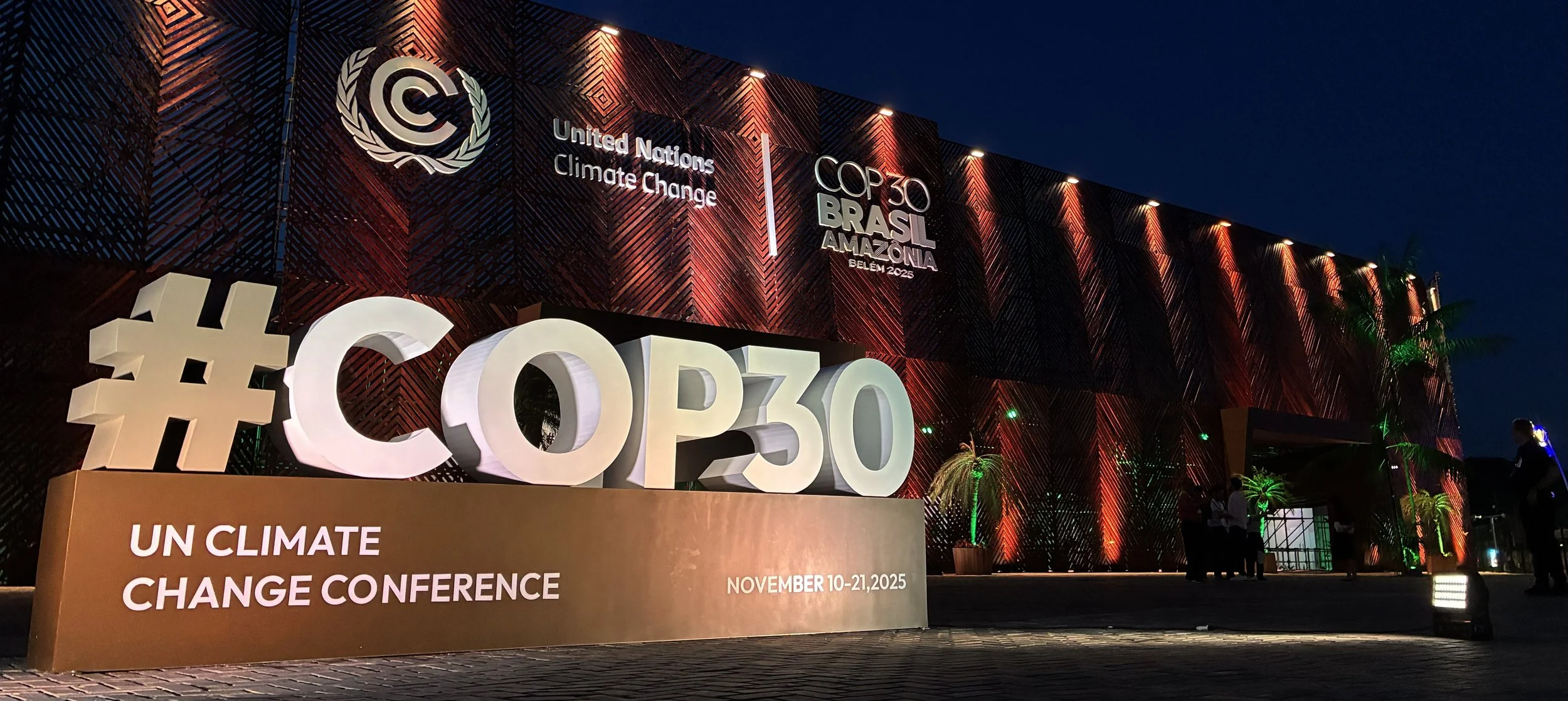
COP 30 was hosted in Belém, Brazil from the 10th to the 21st of November this year. This conference was overall underwhelming in terms of progress made on global climate goals, action, and financing. Although new targets were set and voluntary frameworks around transitioning to a low carbon economy, progress was not sufficient to stay in line with the necessary reductions needed to achieve the below 2°C of warming outlined in the Paris Agreement.
Discussions were had around climate finance, adaptation commitments, scaling up renewables, and centering people and participation in the climate transition. However, most discussions and final decisions fell short of expectations and what is required to truly progress a just transition that will adequately address the climate crisis.
As businesses, the key takeaways from COP 30 to understand are:
Regardless of the lack of progress at the international level, national targets, like those set by Ireland, for emissions reduction remain in force. Meeting these targets will require action by all areas of the economy.
Climate change is already impacting businesses and actionable, ambitious sustainability strategies are needed to ensure resilience and future proof your business.
COP 30 sees the implementation of a Climate Action Agenda that is set to mobilise investment into clean energy technologies and grid infrastructure. This aims to promote the green transition and the creation of green jobs.
A Global Implementation Accelerator was agreed upon that will aim to speed up the actions countries need to take to close the gap between current emissions and those needed to be in line with the Paris Agreement.
Businesses and other private actors need to take decisive action to reduce their own emissions and increase their overall sustainability. The lack of progress at COP is a negative for our communities and for our business operations as it undermines future resilience.
United States Regulations
In general this year, the US has pulled back on sustainability legislation in nearly every way possible, including through attacks on ESG and DEI. Federal climate reporting regulations, expected to come from the Securities and Exchange Commission, have been abandoned. Businesses operating within the US should not expect to face any federal sustainability regulations in the new year.
On the state level, we are still seeing creation and implementation of sustainability legislation in a few places. For example, California is still forging ahead with SB 253 and SB 261 in 2026, their Climate Corporate Data Accountability and Climate Related-Financial Risk acts respectively. These pieces of legislation apply to large private and public companies doing business in California. Businesses with greater than $1 billion in revenue will need to disclose their emissions while businesses with revenue greater than $500 million will need to report on climate-related financial risks. Similarly, Illinois is working to pass a bill that would require companies doing business in their state with over $1 billion in revenue to publicly disclose their emissions starting in 2027.
Despite inaction, or reversal of positive actions regarding sustainability, on the federal level, individual states and cities are still working towards climate goals and emissions reductions. If your business operates in the US, we recommend that you look specifically at the laws and regulations in the states, counties, and cities in which you operate.
United Kingdom Regulations
The UK is currently completing the consultation period on their updated Sustainability Reporting Standards (SRS). It is expected that disclosures under these standards will become mandatory for 2026 or 2027 financial year data. The framework will largely mirror the International Sustainability Standards Board’s IFRS S1 and S2, meaning that they will be broadly aligned with global best practices and disclosure standards.
These standards are expected to apply initially to larger UK companies, especially those listed on UK exchanges, under the Financial Conduct Authority’s remit, with a potential for a widening scope in the future. Despite mandatory reporting requirements only being for large companies at the start, suppliers and upstream partners will increasingly be asked to provide verified emissions data, energy usage information, and other ESG inputs. Value chain information will be a key part of the SRS disclosure requirements.
With the completion of the consultation period imminent, we expect more clarity on the exact timeline for disclosures to come in the new year. In the meantime, ensuring that you have access to quality ESG information and data about your business will help you prepare for data requests and any reporting requirements you may face.
Certification Spotlight: Updated B Corp Standards
As a B Corp, who supports other companies on their B Corp certification journeys, we wanted to take some time to highlight the new B Corp standards. This update also gives us the opportunity to discuss the Empowering Consumers for the Green Transition Directive from the EU, as it directly impacted the updates to the B Corp standards and certification process.
B Corp and Empowering Consumers for the Green Transition
B Lab have launched the B Lab Standards V2.1 with the goal of creating a more rigorous, transparent, and globally aligned framework. This will strengthen how businesses who undertake B Corp certification are able to demonstrate their impact while leading the way to a more inclusive, equitable, and regenerative economy.
Under the new standards, all businesses will start with a set of foundation requirements. These requirements will ensure that you meet eligibility for B Corp certification. In this step, you will also commit to stakeholder governance through the B Corp Legal Requirement and conduct a risk assessment that will determine any due-diligence requirements that must be completed during the certification process.
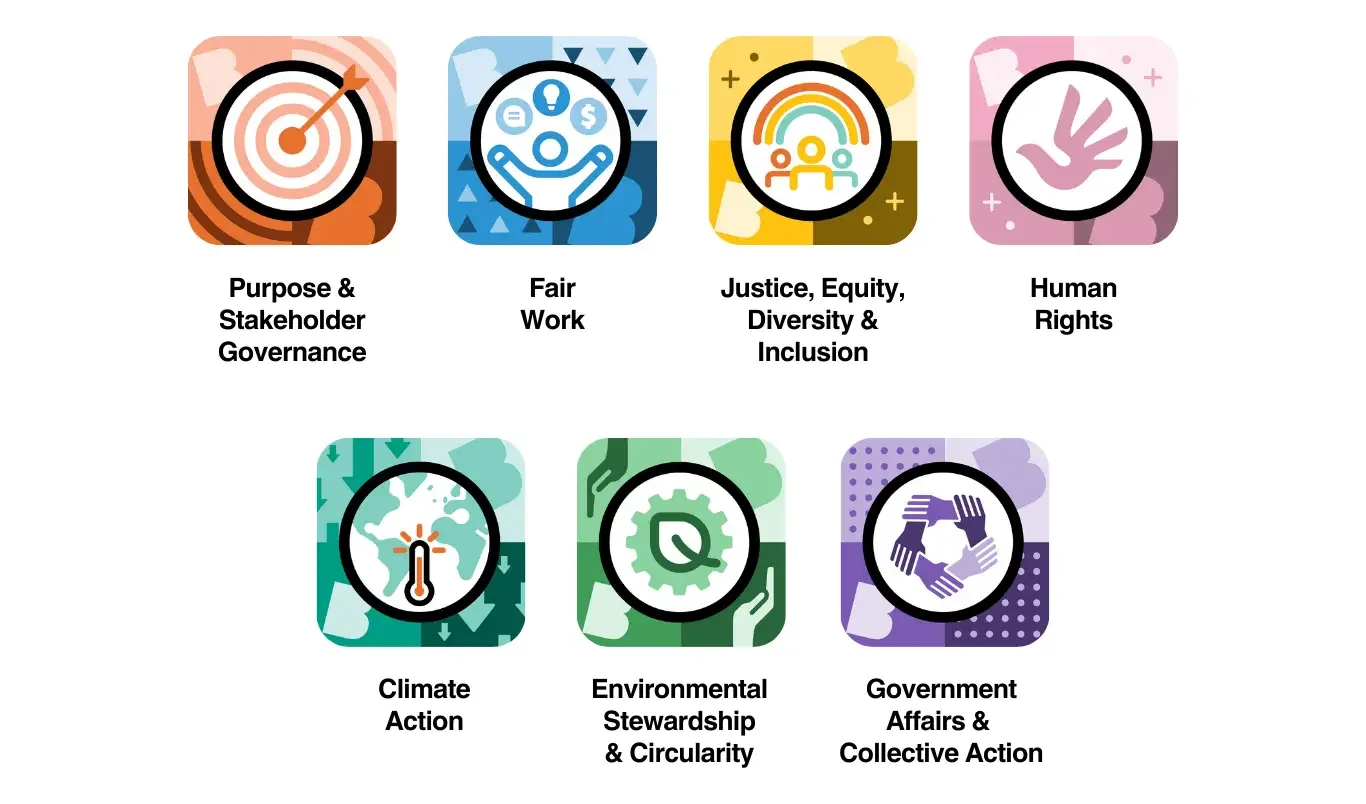
After completing the foundation requirements, businesses will move into the impact topic requirements. The new standards require you to take action across all seven topic areas. These topic areas are:
The exact number and nature of requirements in each of these areas will depend on the size, sector, and industry of your organisation. By taking action in each of the above categories, as well as completing the foundational requirements, you will ensure that your business is taking a well rounded approach to sustainability.
On top of the updates to the standards themselves, B Lab has made updates to the certification requirements to align with the EU’s Empowering Consumers for the Green Transition (ECGT) Directive. This directive aims to ensure that consumers have accurate information with which to make purchasing decisions and that they are protected from unfair commercial practices like greenwashing and planned obsolescence. B Corp have taken action to align with this through requiring third-party verification or certification, enforcing continuous improvement and robust documentation and proof point standards for green claims, switching to mandatory foundational requirements, and ensuring that B Corp communications are transparent and understandable. Accountability and knowledge sharing will be key focuses of B Lab as all B Corps move to align their communications and actions with the ECGT Directive.
What this Means for SMEs
With all of the changes and updates in the sustainability space, it is important to take a step back and discuss why this all matters and what it actually means for your business. As SMEs, there are a few key actions that we can take to ensure that we are aligned with changing sustainability legislation and information requests while also creating a competitive advantage with transparent, substantiated communications.
Create a sustainability strategy that is integrated with and connected to your overall business strategy: sustainability connects to all aspects of your business and it is important that your strategy reflects this. Whether you already have a sustainability strategy or are working on creating your first one, it is important to take a step back and look at how your sustainability goals and actions connect to your overall KPIs as a business. Finding connections between the two will help you to drive sustainability action, as it will directly impact how well your business grows, gains new clients, increases efficiency, and achieves its overall KPIs
Set measurable targets that have actual action plans backing them up: with changes in sustainability communication regulations, like the EU ECGT Directive, it is incredibly important to be able to back up your targets with completed and planned future actions. It is no longer enough to just state your target, you now need to be able to explain how you will reach it. For example, if you have set a net zero target, make sure to communicate just as thoroughly about the steps you have taken and plan to take to achieve your goals.
Gather your data, proof points, and supporting documentation: With new reporting requirements for larger businesses, you will likely be in the supply chain of an organisation that is reporting on their sustainability. This means that they will need to gather information about your sustainability metrics, like emissions, human rights policies, and codes of conduct, to complete their own reporting requirements. We highly recommend gathering your sustainability data now and organising it in a way that makes it easy to respond to information requests.
Get started with the VSME framework: The VSME framework is one of the best ways for SMEs to organise the sustainability information they already have and to identify gaps that need to be addressed. The VSME was created in tandem with the CSRD guided by large amounts of stakeholder engagement. This means that by completing the VSME you will be prepared to respond to the vast majority of information requests. The framework covers all key sustainability considerations for businesses, guiding you through the selection and presentation of supporting data points. Start with the Basic Module of the VSME, organise what information you already have, and then move on to filling the gaps. To learn more about the VSME check out our white paper here.
Create a Sustainability Team and work towards continuous improvement: It is incredibly important to keep your sustainability information up to date and to ensure continued progress towards any targets you set. A Sustainability Team, or Green Team, is a great way to make this happen. Progress will not be linear, there will likely be some months where very little progress is made because of other focus areas, some months where huge strides are made, and everything in between. What really matters is that you have an individual or, ideally, a team that meets regularly to check in on progress and to make sure that sustainability considerations do not get left behind amidst all other business considerations. Sustainability truly is a journey. We are all learning and striving to make improvements where we can. Having a solid team in your organisation responsible for sustainability can help you do just that.
Conclusion

The rollback in scope of many of the sustainability regulations in the EU and across the world has absolutely been disappointing from our perspective at ENSO. Not only is sustainability crucial to addressing global challenges like climate change and labour rights issues, it is also critical to current and future business operations. Sustainability planning and implementation promotes long term resilience, efficiency, and best practices for your business while giving you a competitive advantage through your sustainability communications. With all this in mind, it is very disappointing to see legislators moving away from sustainability requirements.
However, as businesses, we have the ability to forge ahead with our sustainability goals, targets, and strategies. Regardless of the changes in legislation, we still have the power to take action, communicate our progress transparently, and collaborate to share knowledge and increase overall business sustainability. Collectively, SMEs have the potential to make a huge positive impact on the environment and society. Because of this, despite the global ESG rollback, we are excited for 2026 and another year of sustainability action.
At ENSO, we will be focusing on helping businesses create and implement their initial sustainability strategies, complete their VSME reports and collate all of their data for transparent, credible and easy-to-share sustainability communications.
Whether for public tenders, sales proposals, data requests or customer communications, ENSO will ensure you are prepared to share your sustainability at the touch of a button.
If you would like to learn more about how to turn sustainability into a real competitive advantage for your business, our team would love to speak with you. Book your complimentary call today through this link.
